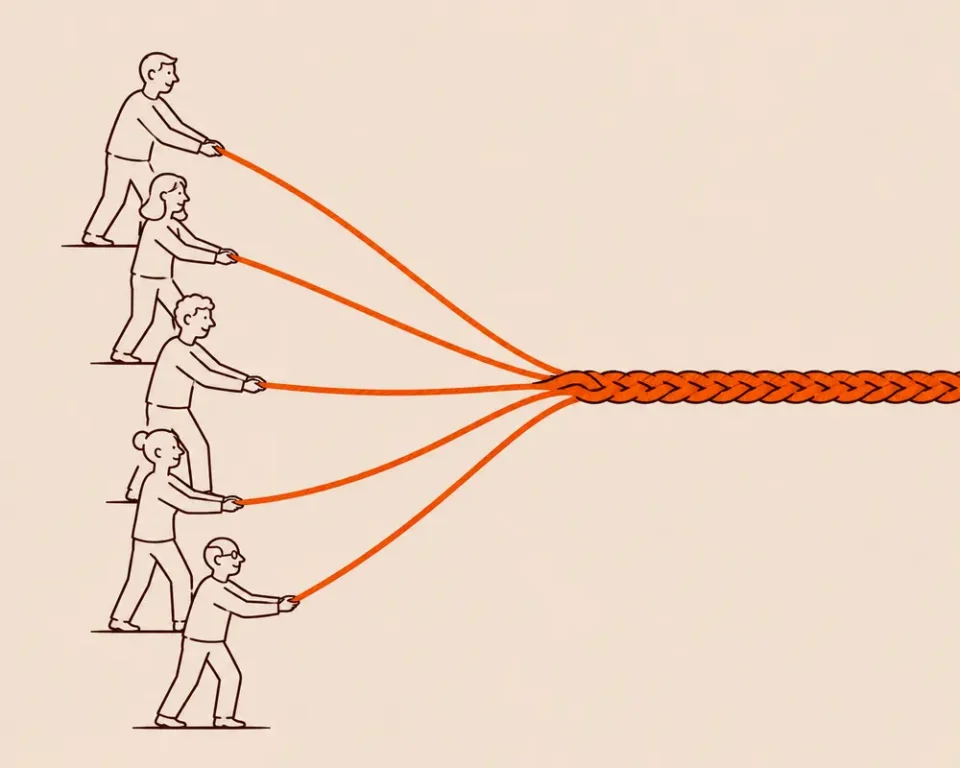

There is a point in every growing family care business where the founder becomes the constraint. Not because they are doing anything wrong — because they are doing everything. Every difficult call, every exception, every judgement about a resident or a rota eventually arrives at the same desk. The business works, and it works because of one person.
The usual diagnosis is that there is nobody good enough to delegate to. Occasionally that is true. Far more often the business has never been arranged in a way that would let anyone else succeed.
“I would delegate if I had someone I could trust.” Trust is not a quality you find in a hire. It is something a business has to be built to produce.
Why trust fails to form
Trust grows out of three things: a clear remit, visible information, and room to make a decision and occasionally be wrong. In many founder-led homes all three are missing. The remit is implicit, the numbers live in the founder’s head, and every decision of consequence is quietly reversed at the top. A manager in that position is not untrustworthy. They are untrusted by design.
The effect compounds. Capable people stop bringing judgement and start bringing questions, which confirms the founder’s belief that they cannot be left alone, which pulls more decisions upward. Within a couple of years the business has a leadership team on paper and a single decision-maker in practice.
Building the conditions instead
Growing a leadership team beyond the family starts with writing down what currently exists only in one person’s head — what good looks like, which decisions genuinely need the owner, what the home’s numbers are, and who is allowed to see them. It is dull work, and it is the work.
Then the harder part: letting a decision stand. Not every decision, and not immediately — but a real remit with real authority, including the authority to make a call the founder would have made differently. That is the moment delegation becomes real, and it is uncomfortable for everyone involved the first few times.
You cannot hire your way out of a structure that was built for one person.
Most owners do not need a different team. They need to make the one they have able to carry more — and that is a question about how the business is arranged, not about the people in it. It is also one of the few changes that makes a business both easier to run and considerably more valuable.